Hagerty and Knight Frank, read carefully
Classic Car Investment Trends 2026: What the Data Actually Shows
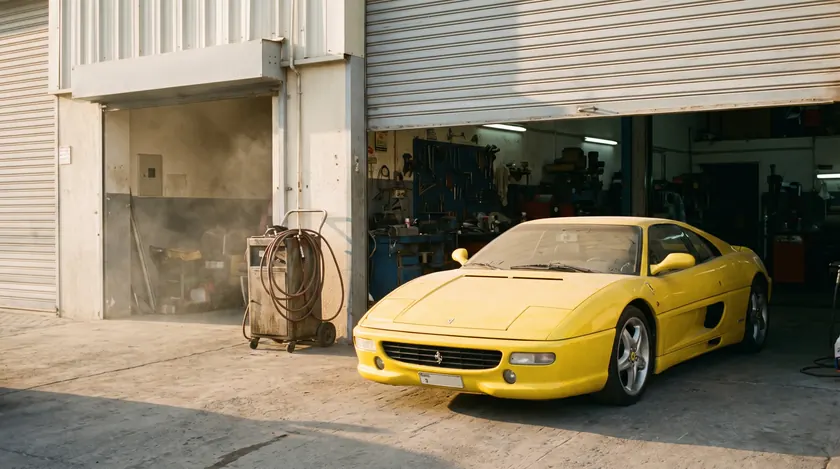
Every client eventually asks some version of the same question: is this car going to be worth more in five years. We would rather answer with the two sources we actually trust, Hagerty's own market commentary and Knight Frank's Luxury Investment Index, than with a confident guess dressed up as analysis.
Both sources say something more specific, and more useful, than 'classic cars go up.' Read past the headline number and the 2026 picture is a market with a genuinely strong top end and a soft underbelly beneath it, not a uniform rise across every car built before 2000.
Are classic cars a good investment in 2026?
Treat this as a question with a real answer, not a marketing line. No asset class is a guaranteed investment, and a classic car carries costs, storage, insurance, maintenance, that a share certificate does not. What the data supports is narrower and more useful than a blanket yes. Knight Frank's Luxury Investment Index puts classic cars up 58.9% over the past ten years, a real, attributed number, not ours. Hagerty's own late-2025 commentary, meanwhile, described the 2026 collector market bluntly as having 'a strong top end but a soft underbelly,' a different claim entirely from 'everything is rising.' We treat a classic car as something you buy because you want it and might do well holding, not as a substitute for a diversified portfolio.
What is the Hagerty Market Rating?
Hagerty publishes its own regular read on the health of the collector-car market, the same source behind the condition-based price bands we quote across our model pages. Its December 2025 commentary, covered by CNBC alongside remarks from Hagerty's own CEO on 2025 sales activity and the 2026 outlook, is where the strong-top-end, soft-underbelly framing comes from. We would treat that framing as the headline finding for 2026 over any single price chart: the market is not moving as one block, and a rating built across the whole market can mask what is happening inside any one segment, which is exactly what the next section gets into.
Which classic cars are expected to increase in value in 2026?
We are not going to guess beyond what is actually documented. Here is what Hagerty itself has flagged, by name, as the strongest movers in the segments we track, starting with the Ferrari F355.
| Model or segment | What the data documents | Attribution |
|---|---|---|
| Ferrari F355 | Named a 2025 Gold Index Pick and Bull Market List entry; excellent-condition values described as having 'almost quadrupled since 2019' | Hagerty |
| Porsche 911 (964) | Condition #3 average around $149,600, up 69% over five years, the strongest five-year gain of any 911 generation per that source | Hagerty |
| BMW E30 M3 | Excellent-condition values around $63,400, a 75.5% rise from a 2015 baseline | Hagerty-sourced market-trend comparison |
| Air-cooled 911s generally | Cited at 5-8% a year appreciation among Gulf collectors specifically buying for long-term value | Regional market commentary, not Hagerty-attributed |
Why are younger buyers changing the classic car market?
We do not have hard demographic data behind this one, buyer ages by transaction, so we will not invent a statistic to answer it cleanly. What we can point to is the pattern in the table above: the fastest-moving cars in Hagerty's own data are the ones a buyer in their 40s and 50s today grew up wanting, 1980s and 1990s Ferraris, air-cooled 911s, JDM icons like the Nissan Skyline GT-R (R34), rather than the pre-war classics a previous generation of collectors prized. The R34 alone spans an extraordinary range by variant, ordinary Japan-domestic examples in the $55,000 to $105,000 band against a Nismo Z-Tune at $1.5 to $2 million, which reads less as one trend than as evidence that documentation and variant rarity now move price harder than age does. That is a reasonable read of the segment data, not a demographic study, and we would rather flag the difference than dress up an inference as a confirmed fact.
Is the classic car market cooling down or growing in 2026?
Both, depending on where you look, which is Hagerty's own framing, not a hedge on our part. The top end, documented cars, rare variants, named Gold Index and Bull Market picks, is described as strong. The rest of the market, ordinary driver-condition cars without a story, is the soft underbelly in the same commentary. A seller with a headline car is in a good market right now, which is exactly the moment a well-run private sale tends to capture the most value. A seller with an unremarkable driver should not assume the same headline growth applies to their specific car.
Prefer to just ask? Send a short message, we reply the same day.
Ask a questionHow does the classic car market compare to art, wine and watches?
Knight Frank's Luxury Investment Index tracks classic cars alongside art, wine, watches and other collectibles inside one broader luxury-assets benchmark, and its 2026 edition was framed around luxury holding steady overall. We have one specific, attributed number for cars from that index, the 58.9% ten-year gain, and we do not have directly comparable ten-year figures for art, wine or watches in the sources we rely on. Anyone quoting a precise head-to-head between cars and wine over the same period is working from a source we have not verified. Check Knight Frank's own published index if a precise cross-asset comparison matters to your decision.
Frequently asked questions
Does Knight Frank's 58.9% figure account for the costs of owning a classic car?
No. That figure reflects Knight Frank's tracked value appreciation over ten years, not net return after storage, insurance, maintenance and transaction costs, which for a real car are meaningfully higher than for art or wine sitting in a vault. Treat the 58.9% as a value benchmark, not a return-on-investment number, before comparing it to any other asset class.
Should I buy a classic car purely as an investment?
We would not recommend it, and we say this to clients who ask directly. Buy a car you actually want to own and use, and treat any appreciation as a possible benefit of ownership, not the reason for it. The soft-underbelly half of Hagerty's own 2026 commentary exists precisely because plenty of driver-condition classics do not move the way the headline segments do.
Is a Ferrari F355 still a good buy after quadrupling in value since 2019?
That is a genuine question worth asking rather than assuming the answer. A car that has already had its documented re-rating by Hagerty is a different proposition from one that has not yet been discovered, and paying today's price assumes the next buyer values it the same way you do. We would size this purchase against condition, documented service history and your own intention to actually drive it, not against the last five years of chart alone.
Do these trends apply the same way in the Gulf and South Africa as they do globally?
Partially. The 5-8% a year appreciation cited for air-cooled 911s is specifically tied to Gulf collector demand, while South Africa's own CAR Magazine has separately noted that air-cooled 911 values are considered to have already peaked in that specific local market. Regional demand does not move in lockstep with the global Hagerty and Knight Frank data, so confirm local specifics before assuming a global trend applies to your market.
Want a straight read on a specific car's trend
Tell us the model and we will tell you what the actual Hagerty and Knight Frank data says about it, not a guess dressed up as one.
Ask a question