British sports icon
Jaguar E-Type for Sale: Price, History and Buying Guide
| Spec | Detail |
|---|---|
| Produced | Series 1 March 1961 to 1968; Series 2 1968 to 1971; Series 3 1971 to 1974/75 |
| Engine | Series 1 early 3.8L inline-6; Series 1 late and Series 2 4.2L inline-6; Series 3 5.3L V12 |
| Power | 265bhp on the 3.8L and 4.2L (246bhp on US-spec 4.2L cars); 272hp on the 5.3L V12 |
| Gearbox | 4-speed manual (early cars lacked first-gear synchro); 3-speed automatic optional from 1966 on the 2+2 and later body styles |
| Notes | Sports coupe (FHC) and roadster, 2 seats (2+2 on the later long-wheelbase coupe) |
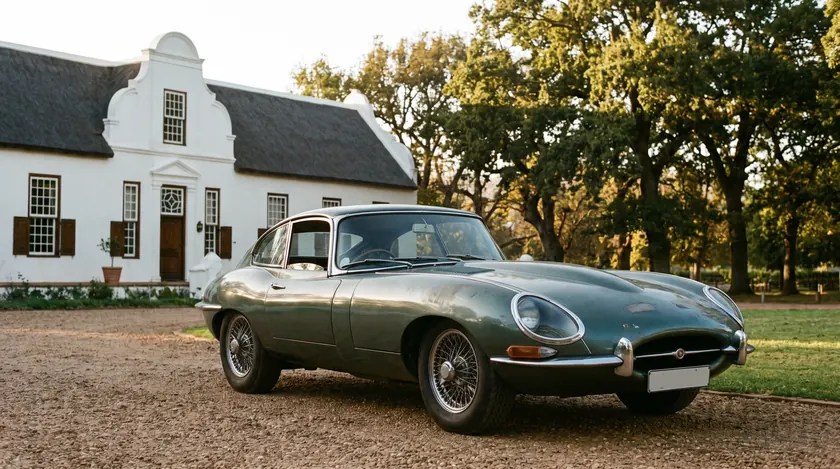
Few classics span as wide a price and specification range under one nameplate as the E-Type. Jaguar built it across three distinct series from March 1961 to 1974 or 1975, starting with a 3.8 liter inline six and ending with a 5.3 liter V12, in roadster, fixed-head coupe and 2+2 long-wheelbase coupe body styles. Buying one means choosing a series and a body style first, price second.
It carries one of the strongest global collector reputations of any car on this list, independent of any single region's demand data. In South Africa specifically, restored Series 2 and Series 3 examples are already a documented, active part of the classic car market, alongside cars from earlier in the model's history.
Jaguar E-Type price in 2026
This model spans an enormous range by series and body style, as of 2026 market range, GBP source data converted to USD. Series 1 3.8 liter roadsters run roughly $114,000 to $248,000, the most expensive path into the model. Series 1 4.2 liter coupes run roughly $47,000 to $153,000, Series 2 roadsters roughly $45,000 to $153,000, and Series 3 V12 roadsters roughly $45,000 to $137,000.
The 2+2 coupes, across series, are generally the most affordable entry point, roughly $24,000 to $81,000. If budget matters more to you than which series you own, start your search there, across the wider classic cars for sale we track, rather than with the roadsters.
Prefer to just ask? Send a short message, we reply the same day.
Ask about a Jaguar E-TypeWhat to check before you buy
The E-Type's monocoque construction means rust hides more effectively than it does on a body-on-frame classic, and its paperwork matters as much as its metal. Work through:
- Monocoque rust hidden under presentable paint: check floor pans, especially on roadsters, sills, door bottoms, front valance, engine rails near the battery, rear arches, boot floor and bonnet seams behind chrome trim.
- Matching numbers on engine, gearbox and body, verified through a Jaguar Heritage Certificate: non-matching numbers were historically common after factory warranty engine replacements.
- The Heritage Certificate also reveals any historical left-hand-drive or right-hand-drive conversion, relevant to originality and value.
- Series 1 cars were notorious for overheating: inspect the cooling system condition closely.
- Oil pressure on the XK straight-six: below 40 to 45psi at 3,000rpm indicates wear.
- On the V12 Series 3, check for head-gasket trouble via bubbling or foaming in the radiator when running: long-stored examples are a bigger risk than regularly driven cars.
- Restoration documentation: a car described as restored with no paperwork on what was actually done warrants extra scrutiny.
Buying and selling privately
An E-Type with a full Jaguar Heritage Certificate, honest restoration paperwork and no conversion surprises sells itself to the right buyer, usually without ever needing a public listing. That is how most serious transactions on this model happen: privately, between a seller who can document everything and a buyer who knows what to ask for.
Photos, the Heritage Certificate and inspection reports for specific cars are available on request via WhatsApp. In South Africa, restored Series 2 and Series 3 examples are already an active part of the market, see classic cars for sale in South Africa for what else is available there now. If you want a contemporary roadster to compare it against, look at the Mercedes W113 Pagoda SL, or a smaller, more affordable classic it is often compared to on styling, the Datsun 240Z.
Ownership reality
A well-established specialist restoration and parts industry exists behind this car, reflecting decades of blue-chip collector status, so mechanical parts are generally obtainable without difficulty. Skilled bodywork on the monocoque, and any restoration that preserves matching-numbers status, is a different matter: that is genuinely expensive specialist labor.
A full engine rebuild runs roughly $7,800 to $13,000 on the six-cylinder cars, more on the V12. Treat those as estimates to confirm with a Jaguar specialist against the specific car's condition, not a fixed budget line.
Have a series and body style in mind?
Tell us Series 1, 2 or 3, and roadster or coupe. We check documentation before we reply.
Ask about a Jaguar E-Type