Affordable JDM entry point
Datsun 240Z for Sale: 2026 Prices, Rust Checks and Specs
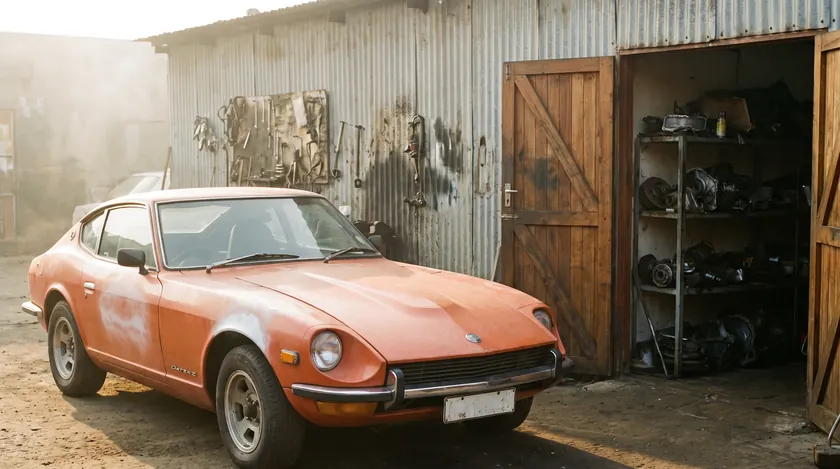
| Spec | Detail |
|---|---|
| Produced | 1969 to 1973 (the S30 platform continued as 260Z/280Z through 1978) |
| Engine | L24 2.4L inline-6 |
| Power | 151hp (SAE gross) |
| Gearbox | 4-speed manual standard, 5-speed manual in non-US markets; 3-speed automatic optional from September 1970 |
| Notes | 2-door GT sports coupe, 2 seats |
A documented South African collection based in the Free State, described as the largest Nissan and Datsun collection in the country, includes multiple 240Zs, one with reported ex-head-of-state provenance. That is an unusually specific data point for a car built more than fifty years ago, and it says something about how seriously this model gets collected outside its home market.
Nissan sold it as the Datsun 240Z from 1969 to 1973, powered by a 2.4 liter L24 inline-six making 151 horsepower, with a 4-speed manual standard and a 5-speed manual available outside the US. The same S30 platform continued as the 260Z and 280Z through 1978, but the original 240Z remains the version most collectors want first.
Datsun 240Z history: 1969 to 1973, and the S30 line after it
Nissan built the 240Z for four model years, 1969 to 1973, and the platform underneath it, the S30, carried on as the 260Z and 280Z until 1978. The engine is the L24 2.4 litre inline-six at 151 hp SAE gross, bolted to a 4-speed manual as standard, a 5-speed manual outside the US, and from September 1970 an optional 3-speed automatic. The reason the 240Z leads that family for collectors is that it is the original: the two-seat GT coupe as first launched, before the later cars' changes.
| Year | What happened | What it means when you buy |
|---|---|---|
| 1969 | 240Z launched on the S30 platform: L24 2.4 litre inline-six, 151 hp SAE gross, 4-speed manual | The earliest cars carry the most collector interest and the most rust years |
| September 1970 | 3-speed automatic offered as an option; a 5-speed manual sold outside the US | Confirm the gearbox against the chassis records, not the seller's description |
| 1973 | Last model year of the 240Z badge | Four model years in total, so the surviving pool is finite |
| 1974 to 1978 | 260Z, then 280Z, continue the S30 platform | Parts overlap keeps a 240Z cheaper to run than its age suggests |
Datsun 240Z price in 2026
Good-to-excellent driver-condition cars trade for roughly $23,000 to $55,000, as of 2026 market range. Hagerty's condition #3 'good' figure is cited at roughly $19,300 to $36,000 depending on year, and recorded 2026 sales anchor the higher end of our range: a 1972 example sold for $55,650 in September 2026, and one exceptional, highly original 1971 car reached $82,500 in April 2026.
That top sale is the exception, not the rule: it reflects an unusually original car, not the going rate for an average 240Z. Judge any car against the $23,000 to $55,000 band first, and treat anything above it as a car that needs to justify the premium with documentation.
| Band | Figure | Note |
|---|---|---|
| Hagerty condition #3, good | about $19,300 to $36,000 | Varies by model year |
| Good-to-excellent driver, our working band | $23,000 to $55,000 | As of 2026 market range; where most documented cars trade |
| Recorded sale, 1972 example | $55,650 | September 2026; anchors the top of the driver band |
| Recorded sale, exceptional highly original 1971 car | $82,500 | April 2026; the exception, not the going rate |
Found a 240Z already? Send the chassis number, the asking price and photos of the floor pans, and we tell you what the rust and the paperwork say.
Ask about a Datsun 240ZOwnership reality
This is one of the better-supported classics of its age anywhere on this list. A very large global enthusiast and parts base exists for a car now over fifty years old, and reproduction rust-repair panels and mechanical wear parts are widely available and relatively affordable, helped by parts commonality across the broader Datsun L-series engine family.
What is scarcer and pricier is genuine new-old-stock trim, badging and brightwork. If originality matters to you specifically, budget extra time to source those pieces rather than assuming they come with any project car you buy. Parts overlap with the later 260Z and 280Z, which share the same S30 platform, is part of why the 240Z stays easier to keep running than its age suggests.
What to check before you buy
Rust is the entire conversation on an unrestored 240Z. Factory rust protection was minimal, and corrosion very often starts on the inside of a panel and works outward, so it can be structurally significant before it is visible from outside. Work through:
- Floor pans rusting through to the underside, especially on coastal or salt-belt cars: check with the carpet pulled back.
- Front frame rails under the footwells and the battery-tray area, where factory rust protection was minimal at best.
- Frame-rail corrosion that starts on the inside and works outward: by the time it is visible externally it may already be structurally significant.
- Chassis rails and tension or compression-rod mounting points, since structural suspension-mount corrosion affects safety and alignment.
- Sills, rockers and lower A and B-pillars, a common rust-progression zone.
- Strut tower rust, which affects front suspension geometry and safety.
- Worn bushings, ball joints and dampers, common on unrestored high-mile examples.
Buying a 240Z abroad: countries, import and what to send
A car this collectible and this rust-prone lives or dies on paperwork: which panels have been replaced, when, and by whom. We treat that documentation as seriously as the car itself when we source or place a 240Z.
A 240Z bought in another country has to clear the destination's import rules before it is yours to drive. The routes we handle are import to the UAE, to Saudi Arabia, to Qatar and to South Africa, each with its own age rule and duty line set out on that page. For the market where the car already has a following, see classic cars in South Africa; for Gulf demand, classic cars in Saudi Arabia and the UAE.
Photos, rust-repair history and inspection reports for specific cars are available on request via WhatsApp. Before we look at a car for you, send:
- Chassis number and model year, plus the gearbox fitted
- Photos of the floor pans with the carpets lifted, the front frame rails and the battery tray
- Photos of the sills, lower pillars and both strut towers
- Rust-repair invoices and a list of the panels replaced, with dates
- The asking price and the city where the car sits now
Compared with its neighbours
If you are weighing it against a later, faster relative from the same maker, look at the Nissan Skyline GT-R (R34), or against the British contemporary it is often compared to on styling, the Jaguar E-Type. The wider field sits on classic cars for sale, and the South African listings on classic cars for sale in South Africa.
Datsun 240Z questions
How much is a Datsun 240Z worth in 2026?
Good-to-excellent driver-condition cars trade for roughly $23,000 to $55,000 as of the 2026 market range. Hagerty's condition #3 figure runs about $19,300 to $36,000 depending on year, a 1972 example sold for $55,650 in September 2026, and one exceptional, highly original 1971 car reached $82,500 in April 2026. Treat anything above the band as a car that has to justify the premium with documentation.
What years was the Datsun 240Z made?
1969 to 1973, four model years. The S30 platform continued as the 260Z and then the 280Z until 1978, with a 2.4 litre L24 inline-six of 151 hp SAE gross in the 240Z, a 4-speed manual as standard, a 5-speed manual outside the US and an optional 3-speed automatic from September 1970.
What should I check before buying a Datsun 240Z?
Rust first: floor pans, front frame rails under the footwells, the battery-tray area, sills and lower pillars, strut towers and the suspension mounting points. Factory rust protection was minimal and corrosion often starts inside a panel, so a car can be structurally compromised before anything shows outside. Then the records of which panels were replaced, when and by whom, and worn bushings, ball joints and dampers on unrestored high-mile examples.
Can I import a Datsun 240Z into the UAE, Saudi Arabia or South Africa?
Yes, through the import route for each country, and the rules differ: South Africa works through an ITAC permit before duty, while the Gulf states each apply their own age rule and duty line. Our import pages for South Africa, the UAE, Saudi Arabia and Qatar set out the steps, and we handle the paperwork alongside the purchase.
Looking for a solid, documented 240Z?
Send the chassis number, the year, photos of the floor pans and frame rails, and the asking price. We check rust and paperwork before we reply.
Ask about a Datsun 240Z