Air-cooled Porsche
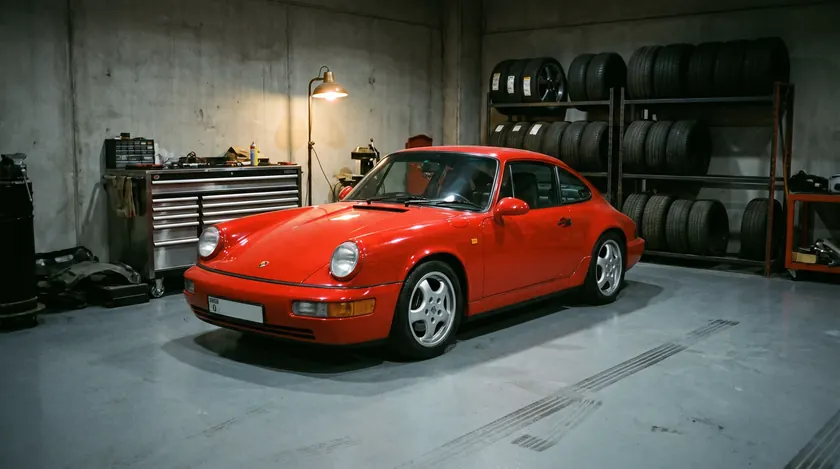
Porsche 964 for Sale: Price, History and Buying Guide
| Spec | Detail |
|---|---|
| Produced | 1989-1994 |
| Engine | 3.6L M64/01 flat-six, naturally aspirated (Turbo used a 3.3L or 3.6L turbocharged flat-six) |
| Power | 250hp (Turbo 3.3: 320hp, Turbo 3.6: 360hp) |
| Gearbox | 5-speed manual (G50) or 4-speed Tiptronic automatic |
| Notes | First Porsche offered with Tiptronic automatic |
The 964 is the 911 that convinced the market air-cooled cars were not finished appreciating. Built from 1989 to 1994, it kept the classic silhouette but modernized the platform underneath: coil springs replaced torsion bars, power steering arrived, and the Carrera 4 brought all-wheel drive to a standard-production 911 for the first time. None of that reads like a headline today, which is exactly why the 964 spent two decades priced like a used car rather than a collectible.
That has changed. Gulf collectors are frequently cited as buying air-cooled 911s specifically for long-term value growth, with returns in the 5 to 8 percent per year range mentioned by regional sources. In South Africa, by contrast, CAR Magazine has suggested air-cooled 911 values in that market may have already peaked, so the growth story is not universal. We treat both as directional, not guaranteed.
Porsche 964 price in 2026
Good-to-excellent Carrera 2 and Carrera 4 coupes trade in a wide band. Collecting Cars UK data, converted from GBP, puts the driver-condition range at $65,000 to $150,000 as of 2026. Hagerty's own condition #3 average sits separately at around $149,600, a figure the same source describes as up 69 percent over five years, the strongest five-year gain of any 911 generation it tracks. Turbo variants live in a different world entirely: the 3.6 Turbo starts around $298,000 and climbs from there.
What actually moves a price within that band is rarely the options list. Matching numbers on engine, gearbox and chassis matter more than trim level. A full, documented service history matters more still, partly because so many 964s spent years as inexpensive used cars, and paperwork from that period is patchy at best. A car with gaps in its history is not necessarily a bad car, but it prices like one. Originality also carries a premium over modification: a numbers-matching, unmolested Carrera 2 will usually beat a well-executed restomod on resale. If you are weighing the 964 against its successor, our Porsche 993 page and the 964 vs 993 buying guide both cover the value gap in more detail.
What to check before you buy
The 964's problems are well documented and mostly about deferred maintenance rather than design flaws. Work through this list before you agree a price, ideally with a marque specialist doing the inspection, not the seller's mechanic.
- Have the cylinder head studs checked for the stretching and breakage that causes oil leaks and rough running, a known 964 weak point.
- Ask when the dual-mass flywheel was last replaced: pre-1992 Freudenberg units failed often, and the 1992-on LUK unit is the more durable fix.
- Check the cylinder base for oil weeping, since pre-1991 heads had no gasket there at all, a fault addressed by a 1991 redesign.
- Test the DME fuel relay or ask if it has been swapped, since a failed relay is one of the more common 964 electrical faults.
- Inspect the windscreen and rear-screen surrounds, rear arches, door bottoms, battery tray and sunroof drains for rust before it reaches the paint.
- On Tiptronic cars, listen for torque-converter noise; on manuals, check clutch and synchro wear, and budget for control-arm bushes and shocks around every 70,000 miles.
- Ask for matching-numbers verification on engine, gearbox and chassis, and treat a car with no service history as a negotiation point, not a dealbreaker on its own.
Prefer to just ask? Send a short message, we reply the same day.
Ask about a Porsche 964Ownership reality
The 964 benefits from the largest, most mature air-cooled specialist parts network of any classic exotic we cover here. Porsche Classic runs a factory parts program specifically for older cars, and the independent world, from small regional specialists to full restoration houses, is enormous by classic-car standards. Parts availability is genuinely good.
Labor is the cost that catches people out. Known issues like the dual-mass flywheel, head stud replacement and rust repair are not expensive because parts are scarce, they are expensive because the work is slow and skilled. Get a quote from a 964 specialist before you buy, not after, and treat any number you are given as an estimate that can move once a mechanic has the car on a lift. For comparison, the BMW E30 M3 from the same analog era carries a similar profile: a durable engine, a small specialist network, and labor-heavy repairs.
Buying and selling privately
Most 964s change hands privately or through a small dealer network rather than at public auction, and that suits a car where documentation matters as much as condition. A private, off-market process lets a seller take time to assemble full service records, a matching-numbers check and an independent pre-purchase inspection before a car is ever shown to a buyer, which protects the price rather than undermining it.
We run that process the same way for every 964 we handle: photos, full spec sheets and inspection reports for a specific car are available on request via WhatsApp, so you are working from real documentation before you ever see the car in person, wherever you are buying from.
Looking for a Porsche 964?
Tell us your budget, gearbox preference and timeline. We will tell you honestly what is realistic right now.
Ask about a Porsche 964